"If society will not admit of woman's free development, then society must be remodeled."-- Elizabeth Blackwell (1821-1910)
This is my first entry in this new blog. I want to use this as a tool for chronicling my dissertation research for myself as well as anyone else who is interested in this project. I will not be digging for about another week, but until then I wanted to provide you with background information about me, Graeme Park and its famous heroine, Elizabeth Graeme Fergusson.
Graeme Park, originally owned by William Keith, a former Colonial Pennsylvania Governor, was developed as a whisky distillery in the 1720s. Over a decade later, the stone structure and the surrounding land was transformed into a tranquil country estate by his son-in-law, Dr. Thomas Graeme, and his daughter, Elizabeth Graeme Fergusson. Although numerous archaeological excavations have been conducted on the premises, there has yet to be an excavation that uses a gendered lens to interpret the cultural landscape. By utilizing the archaeological record, my research attempts to answer the question: Using 21st century technology, can Elizabeth be extracted from the archaeology?
Born February 3, 1737, Elizabeth was the daughter of Thomas Graeme, a prominent physician, and Ann Driggs, the step-daughter of William Keith. In a period where most women were denied education, her parents and tutors encouraged her curiosity and desire for knowledge. Elizabeth even took it upon herself to expand her comprehension in such areas as literature, history, and languages. Remarkably, she even read classical literature in the original languages (Osterhout 2003:xiii). Her love for art, literature, and nature is reflected in her countless extant poems and letters.
In 1739, Dr. Thomas Graeme and his family moved to Fountain Low, the name bestowed on the property by Keith. Renaming it Graeme Park, Graeme and his daughter set about transforming the industrial site into a tranquil Georgian retreat. Elizabeth was highly influential in the renovations to both the land and the house itself. The most palpable changes at Graeme Park can be dated between 1755 and 1764 as a result of extensive documented correspondence between the Graemes and their friends and family.
Unfortunately, little evidence remains regarding the formal garden. An 1854 lithograph depicting Graeme Park and the formal garden has been documented; it is a copy from a pastel that tenuously dates to 1755. Furthermore, written accounts of the garden are scarce. In 1755, Dr. Graeme writes to John Penn that there was “not much yet regarding the House and the Gardens” (Historic Site Report in HABS: 2000). Additionally, in 1787, Elizabeth placed the property for sale. In her ad she writes, “A garden containing two acres adjoining the mansion house, enclosed by a terrace and stone walls” (Pennsylvania Packet, 29 August 1787).
Peter Leach, Geoarchaeologist at John Milner Associates, Inc., conducted the Geophysical Survey in April 2011; it was the first of its kind at Graeme Park. The area was chosen as a result of Susan Kardas and Edward Larrabee’s exploratory garden excavation (1985). Their project revealed multiple cultural features: a walk that ran near the central axis of the yard; soil changes that suggest secondary paths and garden beds; a second walk on the northeast side of the house; a third walk on the southwestern side of the house; and clear evidence of a stone wall on the east side and the north of the house (Kardas and Larrabee 1985:21).
The results are as follows:
- Two long, linear anomalies with obvious right angles – these two anomalies could be buried walls. The anomalies are present between 1 and 2.5 feet below surface (in orange)
- An area of possible rubble in the upper right section of the GPR grid (in purple)
- Two possible shaft features that extend from roughly 0.5 ft to 2.5 feet below surface (red circles with a black dot)
- Three linear stratigraphic anomalies that may represent the signature of previous excavation trenches (red lines)
- Two linear features that run across the yard, which are clearly modern utility lines (gray lines)
- An area of likely root disturbance around the large tree (yellow/green) (Leach 2011: 2)
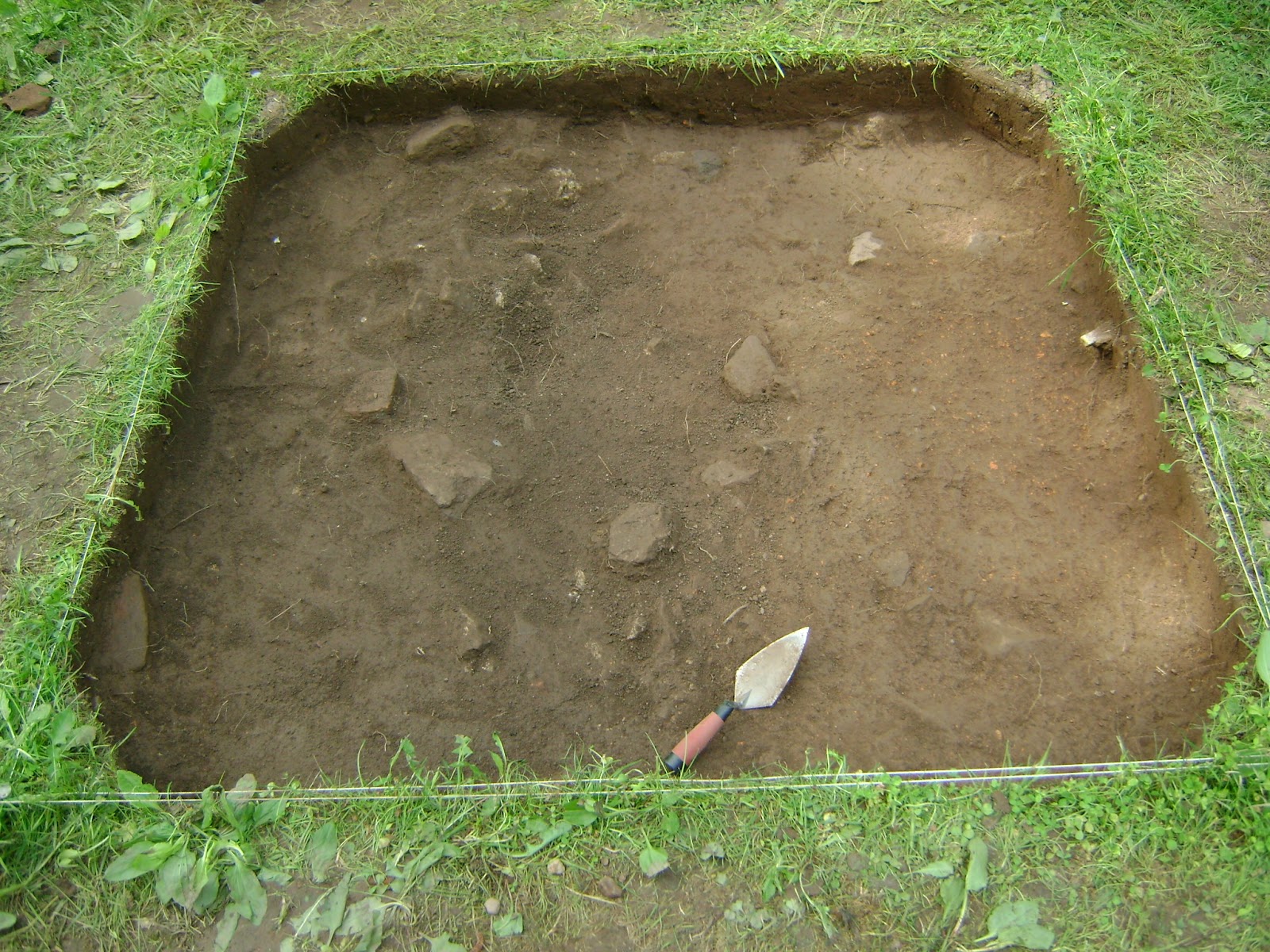
Using the GRP results, I have identified seven areas of interest. I plan to conduct test excavations on three possible shaft features, three areas along the buried walls and a seventh unit located in a minimally disrupted area to serve as a control.
At the core of this project is the attempt to “find” Elizabeth Graeme Fergusson in the archaeological record by applying a gendered lens. Elizabeth was famous for holding intellectual salons with major social players of the day, including Benjamin Franklin and Benjamin Rush. She entertained her prominent guests inside her home as well as within the stone wall confines of the garden. Elizabeth also used the garden, as well as Graeme Park in general, as her muse for her literary pursuits.
Touted as “one of the most learned women in America,” (Anne H. Wharton in Ousterhout 2003: xiii), Elizabeth had two distinct personas. She exemplified what it meant to be an elite female in the 18th century—gentility, refinement, patriotism, and hospitality. However, there was another side to this woman that rejected 18th century gender norms. By excavating her garden, a site latent with rich history and material culture, I hope to merge Gender Archaeology and Garden Archaeology to further our understanding of this unique colonial woman and the garden that inspired her intellectual accomplishments.
For more information on Graeme Park, visit:
Friends of Graeme Park
The Graeme Park Commonplace Book
Graeme Park on Facebook
Sources:
Historic American Buildings Survey (HABS)
2000 Graeme Park, HABS No. PA-579.
Kardas, Susan and Edward Larrabee
1986 Exploratory Garden Archaeology at Three Historic Sites: Graeme Park, Pennsbury Manor and Moon Williamson House. Princeton, NJ.
Leach, Peter
2011 Graeme Park GPR Summary.
Ousterhout, Anne M.
2003 The Most Learned Woman in America: A Life of Elizabeth Graeme Fergusson. University Park: The Pennsylvania State University Press.
Pennsylvania Packet. 29 August 1787.